



An answer capsule is the short, plain answer you write straight under a heading that asks a question. It is the part of a post most likely to be lifted whole, by a reader in a hurry, by a featured snippet, or by an AI search tool building its reply. This post shows how we write answer capsules, with before and after examples from our own drafts.
It is part of our guide to being found in AI search, which covers the wider picture. If you want the one-line version first, read the glossary entry for this term.
What is an answer capsule? #
An answer capsule is a short, plain answer placed directly under a heading that asks a question. It runs forty to sixty words, makes sense on its own, and settles the question before any detail starts. A reader in a hurry can stop there. A search tool can lift it whole and quote it without edits.
Why forty to sixty words #
Shorter than that and the answer has no room for the one condition or example that makes it useful. Longer and it starts to carry two ideas, so a tool that quotes it has to cut. The range is a house rule, not a law of search. Our blog engine checks it on every post: you can see the check at work in our tour of the linter and editor.
Why do AI search tools quote answer capsules? #
AI search tools build their replies from short passages they can lift from a page. A passage that answers the question in full, names its subject, and needs no sentence before it to make sense is easy to lift. An answer capsule is built to be that passage, so you give the tool a clean one to quote.
The same capsule serves featured snippets #
A Featured snippet is the boxed answer Google sometimes shows above the usual results. It draws on the same kind of passage: a direct answer under a clear heading. Google's page on how featured snippets work says the snippet is chosen automatically, and that you cannot mark up a page to ask for one. What you can do is write the answer so it is easy to choose.
Our post on how AI search picks the pages it cites makes the same point. The easiest passage to quote is one that stands alone under a question heading.
How do you write an answer capsule? #
Start with the question as a heading, in the words a reader would type. Under it, answer in the first sentence, using the subject's name instead of a pronoun. Add one or two sentences of the most useful detail: a condition, a number or a next step. Stop at sixty words, then move the rest below.
Before and after #
Here is a capsule from one of our own drafts, before and after the edit. The question was "Should a blog post have a table of contents?"
Before
Tables of contents have been around for a long time, and opinions on them vary a lot. In our experience, it really depends on the post. That said, there are some cases where they can arguably help, as we will explore in the sections below.
After
Yes, for any post long enough to need scrolling. A table of contents lets a skimmer jump to the part they need, and it gives search engines named links into each section. Skip it on short posts, where it only pushes the answer further down the page.
The first version never answers. The second says yes in its first word, gives the reason, and names the exception. Nothing in it depends on the paragraph before.
A checklist for every capsule #
- The heading is a real question and ends with a question mark.
- The first sentence answers it, and would make sense read aloud on its own.
- The subject is named, not "it" or "this".
- The answer runs forty to sixty words.
- No hedge words, no links, and no "as mentioned above".
- The detail, the caveats and the examples sit below the capsule, not inside it.
What mistakes stop a capsule being quoted? #
Three mistakes do most of the damage. Hedging makes the answer sound unsure, so readers and tools have less reason to trust it. Burying the answer behind a warm-up sentence means the passage no longer stands alone. A link in the first sentence pulls the reader away before they have the answer, and breaks the flow.
The mistakes in detail #
| Mistake | Example | Fix |
|---|---|---|
| Hedging | "It can arguably help in some cases." | Say what you know: "It helps on long posts." |
| Burying the answer | "Before we answer, some history." | Put the answer first, history after. |
| A link in the first sentence | "As [our guide] shows, yes." | Answer first, link in the detail. |
| Leaning on the post | "As we said above, no." | Restate the subject so it stands alone. |
| Two questions at once | "Yes, and also you should..." | Give the second question its own heading. |
Our linter flags the common hedge words under question headings for this reason: "arguably", "basically", "perhaps" and their cousins. Each one makes the answer weaker and adds nothing a reader needs.
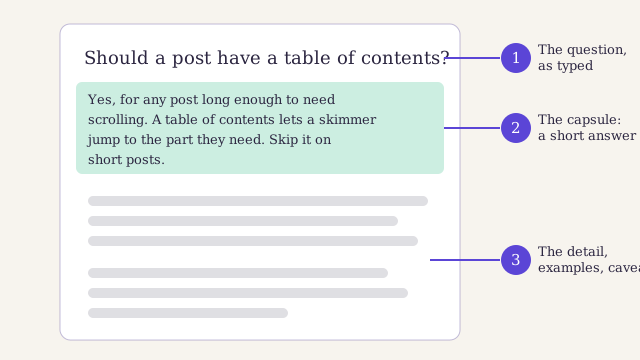
The shape of a section built around a capsule. Notice that the capsule sits between the question and the detail, so a tool can lift it without taking anything else.
Questions about answer capsules #
Does every post need answer capsules?
No. Use them where a heading asks a real question. A step-by-step guide or a story needs few of them, while a post that answers common questions may have five or six.
Can a capsule hold a list?
Keep the capsule itself as a paragraph, so it can be quoted as one passage. Put a list straight after it if the answer has steps or parts.
Should answer capsules be written for AI or for readers?
For readers. A plain answer near the top helps a person in a hurry, and the same qualities make it easy for a tool to quote. If the two ever pull apart, write for the person.
Signing up by email is not open on this site.