
Search intent explained for content writers

Reviewed by 
Published
Filed under SEO writing

Search intent is the goal a person has when they type a search. They might want to learn something, reach a page, weigh options or buy. If your post serves a different goal from the one the searcher has, it will not rank for long, however well it is written.
This post is part of our guide to writing posts that rank, and lesson one of our free SEO writing course. It shows how to read the goal behind a search before you plan a single heading.
Four goals behind a search #
Writers sort searches by intent into four broad groups. Most searches fit one of them:
- Know. The searcher wants to learn or understand. "What is a canonical tag" or "why is my sourdough flat".
- Go. They want a page they already have in mind, such as a login page or a brand's pricing page.
- Compare. They are weighing options before they decide. "Best project tools for small teams" or "monthly or yearly plan".
- Buy. They are ready to act. "Book a dentist near me" or "order business cards".
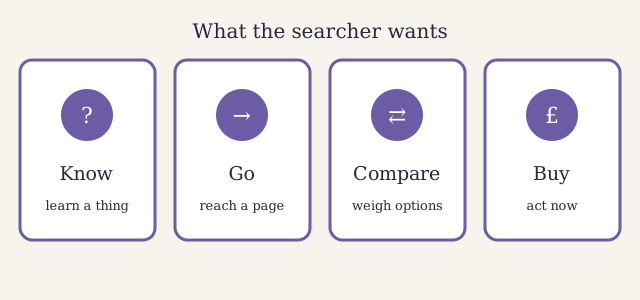
The four goals. A blog post usually serves "know" or "compare". Product pages serve "buy".
A blog is at its best on "know" and "compare". When a search is really about buying, the results page fills with shops, and a blog post has little chance of a place, however good it is.
Read the results page first #
You do not need a tool to find the search intent. The search engine has already worked it out, and it shows you on the results page. Search the phrase in a private window and study the first page for ten minutes.
Look for these signals:
- The kind of page. Guides, lists, shop pages, tools or videos.
- The angle. "For beginners", "in five minutes", "free", "for small teams".
- The extra boxes. A short answer box means a quick fact. A map means a local need. Product cards mean buying.
- How fresh the pages are. Dated titles suggest searchers care about recent advice.
Know pages compared with compare pages #
The two goals a blog serves most often need different pages. The table sets them side by side.
| Know pages | Compare pages | |
|---|---|---|
| What the reader wants | To understand one thing | To choose between options |
| Best opening | A plain answer in the first lines | The options and who each suits |
| Shape | Headings that explain, then examples | A table, then a section per option |
| Proof | Clear examples and sources | Honest pros and cons, tested claims |
| Ending | What to do next | A recommendation for each type of reader |
Mixed goals on one results page #
Some searches carry two goals at once. "Email marketing" might mean "what is it" for one person and "which tool" for another. The results page shows the mix: a guide at the top, a list of tools below it, maybe a video.
Serve the main goal
Find the goal behind most of the top results and write for it. Give the second goal one short section near the end, with a link to a page that serves it in full.
Or split the page
If both goals are strong, write two posts. One answers "what is it", the other compares the options. Link them to each other so a reader can move between them.
Shape the page to the searcher's goal #
Once you know the search intent, it decides most of your choices:
- The title. It should promise the thing the searcher wants, in their words.
- The first lines. Settle the question early for "know" searches. Name the options early for "compare" searches.
- The depth. Match the depth of the pages that rank, then add what they miss.
- The next step. Point to the page a reader needs after this one.
The words searchers see before they click matter too. Our post on writing a meta description that earns the click covers the snippet under your title.
When search intent changes #
The goal behind a phrase can shift. A phrase that once returned guides can start to return tools, or news, when something changes in the market. In our yearly benchmark of small business blogs, posts that lost their place often still matched the old goal, not the new one.
Check the results page again whenever an important post starts to slip. If the kind of page that ranks has changed, change your page, not just its date.
Search intent and AI answers #
AI search tools read the goal too. For a "know" question they often give a short answer and quote the page that put it most plainly. Our research on how AI tools pick the pages they quote shows what those pages have in common, and our guide to writing for AI search turns it into a plan.
A page that serves the right goal, with a plain answer near the top, is the page both readers and AI tools want. Google's own guide to how search works describes the same idea: results are chosen for what the searcher meant, not just the words they typed.
About the author
Head of content at Larkspur Studio
Experience Twelve years as a newspaper sub-editor and content lead, MA in Journalism
Maren runs the writing desk at Larkspur. Before that she spent eight years cutting other people's copy to fit a newspaper page, which is where she learned that every sentence has to earn its place. She writes about planning posts, structuring them and editing them until a busy reader can act on them.
Reviewed by